顯示具有 SPD3159 標籤的文章。 顯示所有文章

2010年11月9日 星期二

H@Museum of Tea Ware

Hello, i'm going to introduce 'Museum of Tea Ware' to all of you, this site bring to Hong Kong a multi-cultural vision of the arts and culture of the world through an international programme of exhibitions.

About the Museum
Specializing in the collection, study and display of tea ware, the branch museum at Flagstaff House features at its core the generous donations of Dr K.S. Lo (1910-1995) , which include many fine examples of the famous Yixing teapots.
Built in the 1840s, Flagstaff House originally served as the office and residence of the Commander of the British Forces in Hong Kong. It was converted to the Museum of Tea Ware in 1984, with a new wing, The K.S. Lo Gallery, added in 1995. Alongside its exhibitions, the Museum holds regular demonstrations, tea gatherings and lecture programmes to promote ceramic art and Chinese tea drinking culture.

There are several type of collections: Chinese Antiquities, Chinese Fine Art, Historical Pictures, Hong Kong Art,  K.S. Lo Collection of Tea Ware and Seals and Xubaizhai Collection of Chinese Painting and Calligraphy.

Also, they have some permanent exhibitions in the museum, which are Chinese Tea Drinking and Chinese Ceramics and Seals Donated by the K.S. Lo Foundation.

This exhibition introduces the history of Chinese tea drinking and features various kinds of tea ware, from the Tang dynasty (618 – 907) to the 20th century. An education corner on “Essential tea vessels”, with hand-on facilities for the people with visual impairment, is set up to give visitors a more comprehensive background on tea utensils and to encourage a culture of tea drinking.

Education Corner

Small teapot with flattened shoulder
How to get there?
10 Cotton Tree Drive, Central, Hong Kong (inside Hong Kong Park)
Tel: (852) 2869 0690 / (852) 2869 6690 (The K.S. Lo Gallery)
Fax: (852) 2810 0021
Free admission

Opening Hours:
10:00 am - 5:00 pm daily
Closed on Tuesdays and the following public holidays:
Christmas Day and Boxing Day
New Year's Day and the first three days of the Chinese New Year


Source:
http://www.lcsd.gov.hk/CE/Museum/Arts/english/tea/tea01.html

2010年11月3日 星期三

C @ King Yin Lei

The 1937-built King Yin Lei is a rare surviving example of Chinese Renaissance style that reflected the design and construction excellence in both Chinese and Western architecture of Hong Kong. The "East-meets-West" construction methods have made the building a rarity in Hong Kong and an outstanding piece of art.The building was sold in 1978 to the Yow family - Mr. Yow Qhei-man and his son Mr. Yow Mok-shing, who gave the name "King Yin Lei" to the building which meant "house of virtuous views".
King Yin Lei, Stubbs Road, Mid-Levels

The building is important in signifying the historical development of Hong Kong. As one of the luxurious historic houses located along the hillside of Hong Kong Island, the building reflects the rising status and growing wealth of the Chinese community in Hong Kong. It also represents an earlier phase of Hong Kong history when the upper-class residential area took shape in the Mid-Levels.

King Yin Lei, Stubbs Road, Mid-Levels


The mansion, built in 1937, sits on a 50 650 square feet site. The three-storey building is a “red bricks and green tiles" mansion of Chinese Renaissance or Chinese Neo Classical Style, which reinterprets traditional Chinese architectural form in the light of western design techniques. A private garden festooned with bonsai plants, various pavilions and terraces encircles the mansion. It has been a scenic spot for mainland and overseas tourists.

The social value of the building also lies in the role it played in the film heritage and entertainment industry of Hong Kong. The mansion has been featured in films of international renown such as "Soldier of Fortune" (1955), "Love is a Many-Splendoured Thing" (1955) .

The building was sold to its current owner in August 2007, and works to remove the roof tiles, stone features and window frames were noticed on site in early September 2007. Restoration works are being carried out and expected to be completed in 2010.


Address: 45 Stubbs Road, Mid-Levels

Sources:
http://gwulo.com/king-yin-lei
www.conservancy.org.hk/heritage/KYL_E.htm
www.heritage.gov.hk/en/doc/KingYinLeiInfo.pdf


2010年11月1日 星期一

H@ Sung Wong Toi


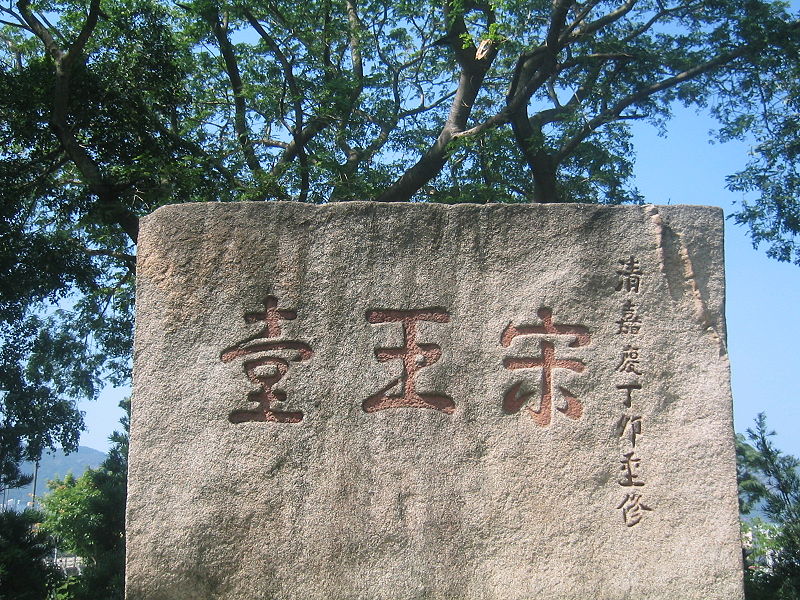
Sung Wong Toi is an important historic relic in Kowloon, Hong Kong. While its remaining portion is currently located in the Sung Wong Toi Garden in Ma Tau Wai, it was originally a 45 m tall boulder standing on the top of Sacred Hill (聖山) in Ma Tau Chung above Kowloon Bay.


The name Sung Wong Toi literally means Terrace of the Sung kings. The stone is believed to have been a memorial to the last two boy emperors of the Southern Song Dynasty, Zhao ShiZhao Bing, who temporarily lived in Hong Kong from 1277 to 1279. and

While it’s true this park is dedicated solely to a rock, there’s much more history behind it than meets the eye. The Chinese characters Sung Wong Toi were inscribed into a large boulder near Kowloon Bay in 1279 as a memorial to the last two boy emperors of the Song Dynasty. Excavation damaged the rock during the Japanese occupation, but luckily the inscription remains intact. A portion was shaped into a rectangular block and is now the park’s centrepiece.

How to get there: Take bus no. 5 or 1A from Tsim Sha Tsui Ferry Bus Terminus and get off at Prince Edward Rd East. Go back to Ma Tou Wai Rd and you will see the park after a few minutes’ walk.

Resource
http://www.timeout.com.hk/around-town/features/37271/hong-kongs-best-parks.html#panel-3
http://en.wikipedia.org/wiki/Sung_Wong_Toi

2010年10月26日 星期二

HL@ Wong Tai Sin Temple

Wong Tai Sin Temple is one of the most famous shrines in Hong Kong. It is dedicated to Wong Tai Sin, or the Great Immortal Wong. The 18,000 m² Taoist temple is famed for the many prayers answered: "What you request is what you get" (有求必應) via a practice called Kau Cim. The temple is located on the southern side of Lion Rock in the north of Kowloon.

Annually, from January 1 to 15, the temple receives numerous visitors, such as those whose prayers were answered returning to thank the immortal. Wong Tai Sin's birthday on the 23rd day of the 8th lunar month, and the Chinese New Year holidays are the busiest times for the temple.
On the Chinese New Year's Eve, thousands of worshippers wait outside the temple before midnight and rush in to the main altar to offer Wong Tai Sin their glowing incense sticks when the year comes. As the tradition goes, the earlier they offer the incense, the better luck they will have that year.

The act of "Kau Cim" at Wong Tai Sin.

Most of the visitors come to the temple in search for a spiritual answer via a practice called Kau Cim. They light incense sticks, kneel before the main altar, make a wish, and shake a bamboo cylinder containing fortune sticks until a stick falls out. This stick is exchanged for a piece of paper bearing the same number, and then the soothsayer will interpret the fortune on the paper for the worshiper. Often the same piece of fortune is taken to multiple booths for verification purposes. Some booths offer palm reading service.
Recently, Taoist weddings have been performed here.

The temple is open from 7:00am to 5:30pm throughout the year, and runs overnight in the Lunar New Year Eve. It is currently administrated by Sik Sik Yuen, a Taoist organization in Hong Kong.

Here is movie which is about the one of the activities were held in last year.


More detalis!

Source:
http://en.wikipedia.org/wiki/Wong_Tai_Sin_Temple
http://www.siksikyuen.org.hk/public/contents/category?lang=iso-8859-1&cid=724

2010年10月24日 星期日

RA@ Nam Koo Terrace

Have you ever heard Nam Koo Terrace (南固臺)? It is one of famous heritage in Hong Kong. As Halloween is coming soon, will you try to experience and to explore this strange and terrible place in there?Do you want to know more now?


Nam Koo Terrace (南固臺) is a Grade I Historic Building. It's located at No. 55 Ship Street, Wan Chai, Hong Kong, popularly known as "The Wan Chai Haunted House". The building is currently owned by Hopewell Holdings, a large property development company based in Hong Kong.


The two-storey red brick building was built in c.1915-1921 and owned by a wealthy Shanghai merchant family by the name of To ().

Nam Koo Terrace continued to remain under the ownership of the To family until 1988, when the property was sold to YUBA Co. Ltd.

Hopewell Holdings took over ownership of the building in 1993, which was initially acquired to be demolished in order to make way for their Mega Tower hotel project (Hopewell Centre II). However, the site has stood vacant since then; despite the fact that the company's development proposal gained Government approval in 1994. While Hopewell Holdings remains the current proprietor of Nam Koo Terrace; recent public announcements indicate that their intentions have now shifted to the preservation, rather than the demolition, of this historical site.


For architecture, it is a site of significant cultural and architectural heritage stemming from Hong Kong's Colonial Era. The building was designed as a European-style house in the 1910s when large private lots on the hillside below Kennedy Road were sold for real estate development.

Beside, it is also a two-storey mansion, incorporating strong elements of both Eastern and Western architectural styles. As one of the more prominent villas in the Wan Chai District, Nam Koo Terrace covers over two hundred square meters of land. It is also referred to as the "red house" because the majority of the building's external wall is constructed from red bricks. Today, the building exists in a ruined state due to the effects of corrosion suffered during the Japanese invasion and ineffective preservation.


As well as embracing the Colonial Eclectic style, Nam Koo Terrace also adopts Classical Revival and Italian Renaissance architectural features combined with traditional Chinese decorations and motifs. The red bricked outer wall of the building is considered to be one of the major features of its architectural construction. Besides the red brickwork; rusticated quoins, moulded cornices, and voussoired arches over the windows add to the uniqueness of the structure's architecture.


Since Nam Koo Terrace has unoccupied for a long time as there are  many haunted rumors. In 2003, there are eight peoples of youth went to abandoned ship Street South to go on an adventure, allegedly, one of the girls was running around and barking, and change the male voice with mighty, should be sent four officers to subdue her finally.

"Nam Koo Terrace" has become a famous place to shooting for horrorible film nowaday, TV series "Finale in Blood (大鬧廣昌隆)" is one of them. Are you feel interested?

Source:
http://zh.wikipedia.org/zh-hk/%E5%8D%97%E5%9B%BA%E8%87%BA
http://www.arch.cuhk.edu.hk/server2/resch/livearch/projects-wanchai_roadshow.html

2010年10月23日 星期六

KW@Hong Kong Heritage - HAW PAR虎豹別墅


Haw Par Mansion 虎豹別墅

ABOUT HAW PAR MANSION

Address:                   No.15A Tai Hang Road, Causeway Bay, Hong Kong
Site Area:                 About 2,030m²
Gross Floor Area:       About 1850m²
No. of Storeys:          4
Year of construction: 1933-1935
Land use zoning:        "Other Specified Uses" annotated "Residential Development with    
                                Historical Site Preserved In-situ" on Approved Causeway Bay 
                                Outline Zoning Plan No. S/H6/14


History

The Haw Par Mansion together with its private garden was built by Aw Boon Haw, who was known as "The King of Tiger Balm". The Mansion was the Aw's family mansion and was restricted to private use, while the Tiger Balm Garden constructed adjoining the mansion was used to be open to the public for enjoyment.

The Tiger Balm Garden has been demolished. The Mansion together with its private garden has been preserved and passed to Government since 2001.


SOURCES:http://www.hkdatabase.com/component/option,com_openwiki/Itemid,2/id,虎豹別墅/

http://www.hkdatabase.com/component/option,com_openwiki/Itemid,2/id,%E8%99%8E%E8%B1%B9%E5%88%A5%E5%A2%85/do,export_xhtml/

http://b.tvb.com/hongkongtopic/2010/10/18/%E6%B4%BB%E5%8C%96%E8%99%8E%E8%B1%B9%E5%88%A5%E5%A2%85/

2010年10月22日 星期五

C@The Hong Kong Observatory

What I want to introduce today is Hong Kong Observatory .Hong Kong Observatory known as the Royal Observatory Hong Kong  before 1997, is a department of the Hong Kong Government. The Observatory forecasts weather and issues warnings on weather-related hazards.


The Observatory was established in 1883 by the 9th Governor of Hong Kong George Bowen. Early operations included meteorological and magnetic observations.The Hong Kong Observatory was built in Tsim Sha Tsui, Kowloon Peninsula in 1883. Observatory Road in Tsim Sha Tsui is so named based on this landmark. The Observatory is now surrounded by skyscrapers as a result of rapid urbanisation. However, it remains unrelocated.

Hong Kong Observatory (134A Nathan Road, Tsim Sha Tsui) 1883 Building
This building, built in 1883, is a rectangular two-storey plastered brick structure; it is characterised by arched windows and long verandas. It now houses the office of the directorate and to serve as a centre of administration of the Observatory.

The Friends of the Observatory, an interest group set up in 1996 to help the Observatory to promote Hong Kong Observatory and its services to the public, provide science extension activities in relation to the works of the Observatory and foster communication between the Observatory and the public, now has more than 7,000 individual and family members in total.
Voluntary docents from this interest group lead a "HKO Guided Tour" to let the public who applied for visit in advance to visit the headquarter of the Observatory, and learn about the history, environment and meteorological science applied by the Observatory.


Address: 134A Nathan Road, Tsim Sha Tsui

 Source:
http://en.wikipedia.org/wiki/Hong_Kong_Observatory
www.weather.gov.hk/contente.htm
www.heritage.gov.hk/en/index.htm

2010年10月18日 星期一

HL@ Hong Kong Museum of Medical Sciences

Have you guys seen the TV programme last night?

The TV programme had introduced the 'Hong Kong Museums of Medical Sciences' (HKMMS) which was located in a renovated 3-storey Edwardian style building, at 2 Caine Lane at the Mid-levels, Hong Kong Island.


 This buidling was established in 1906 and called "Bacteriological Institute" previously. Later, it was called "Pathological Institute" after The World War II.


The Museum occupies 10,000 square feet, comprising 11 Exhibition Galleries, 1 Gallery for Tai Ping Shan View, 1 Library and 1 Lecture Room, each presents in a variety of ways to arouse interests and to help members of the community know more about health and diseases, including past conquests, current developments and future challenge of special relevance to Hong Kong. It also explores the interface between Chinese and Western medicine and encourage research in this area. It intends to serve both as an educational venue and to restore and conserve medical objects of historical value. As such, it is the first of its kind amongst medical museums in the world!

About their objectives, they want to exhibit and educate the public about Hong Kong's medical history as well as to preserve historical medical materials relating to the local development of medicine. Occasionally, special activities are held by the museum to inform the public about medical information and news. Publications and leaflets are also distributed to the public occasionally so as to help arouse the interest of the public in the medical history of Hong Kong and increase their knowledge and understanding of health and diseases. This museum is special and meaningful since it is the first of its kind among all the medical museums in the world.


This is the Herbalist Shop of HKMMS which included Chinese herbal medicines and the
traditional Chinese medical practitioner's equipment.

The design of this room is in accordance with the traditional style and concept of a Chinese herbalist shop. We can recognize many herbs from the Chinese herb shop and some them we might have actually taken before.
  

How to get there?

The museum closes on Mondays but is open to the public from 10:00a.m to 5:00p.m from Tuesday to Saturday. On Sundays and public holidays, it starts at 1:00p.m. and closes at 5:00p.m. The admission fee is HK$10.00 for adults and $5 for the disabled people, full-time students and the elderly aged 60 or above. 
  

By "Central - Mid-Levels Escalators"
Use the "Central - Mid-Levels Escalators" (after 10:30am) from Central to Caine Road, and walk westwards for around 10 minutes till you reach Ladder Street. Descend Ladder Street and turn left after the first flight of steps into Caine Lane. The Museum is down Caine Lane, on your right. [Dynamic Route (Central Market - Museum)]


The video will let you know more about Hong Kong Museums of Medical Sciences.
Check it out!

Source: 
http://www.hkmms.org.hk/
http://en.wikipedia.org/wiki/Hong_Kong_Museum_of_Medical_Sciences
http://www.discoverhongkong.com/tc/attractions/museum-medical-sciences.html

2010年10月15日 星期五

RA@ Woodside

Do you remember what I’m talking about last blog? It’s talking about “Blue-House” previously. Do you want to know more about heritage which is related to different types of house in Hong Kong? There are several special houses in Hong Kong, we will introduce these special one: Woodside.


Woodside (林邊屋又稱「紅磚屋」)  is a huge colonial-style mansion. It’s situated in the lower portion of the Mt Parker Road trail in the Quarry Bay Extension of the Tai Tam Country Park. It’s classified as Grade II historic building now.

This elegant colonial house in Tai Tam Country Park (Quarry Bay extension) was originally called Woodside. Because of its red brick and granite structure, it is often known as the Brick House or Red House.

Woodside was built as the residence of the manager and engineer of Taikoo Sugar Factory. After closure of the factory, the residence was reverted to the Government in 1976.


Woodside was built in the early twentieth century. Originally, it stood as two individual buildings, named Woodside 1 and Woodside 2. The two houses were flanked with a garden, and featured Chinese tiled roofs.

During the Pacific War, Woodside was used by the Japanese. Their occupation of the house resulted in extensive damage and, after the war; Swire renovated the house between 1947 and 1951. The roofs were removed and the two separate buildings were connected.


Today, as a century of change, Woodside greets visitors with its old charm – with the original wooden stairs, floorboards, doors and balconies. Between the late nineteenth and early twentieth century’s, staff quarters of the Taikoo Sugar factory and Taikoo Shipyard spread around Quarry Bay and Shau Kei Wan.

Nowadays, only Woodside remains. This charming old brick house is the only remaining colonial-style residence in the area.

According to the news, Agriculture, Fisheries and Conservation Department has been received in 2002, it will rebuild this building to a nature education center in coming two or three years. This project is expected to be completed in 2012 as possible.


Will you go to there? I think it's a mystery place :)

Sources:
http://zh.wikipedia.org/zh-hk/%E6%9E%97%E9%82%8A%E5%B1%8B
http://www.cahk.org.hk/heritage/woodsideC.htm
http://www.hkheadline.com/news/html_wnn/html/2009/11/6/wnn93444.html?section_name=wnn