顯示具有 Key heritage in Hong Kong 標籤的文章。 顯示所有文章

2010年11月19日 星期五

RA@ Hong Kong Catholic Cathedral of the Immaculate Conception

The Hong Kong Catholic Cathedral of the Immaculate Conception (traditional Chinese: 聖母無原罪主教座堂) is the Roman Catholic Cathedral of the Catholic Diocese of Hong Kong. It is the seat of the Diocesan bishop, currently John Tong Hon. The Cathedral is one of the two cathedrals in the city of Hong Kong, the other being the Anglican St. John's Cathedral.


It is located at 16 Caine Road, Central. It is open from 7:00 am to 7:00 pm daily. It is graded as Grade I Historic Building.

The first Roman Catholic cathedral of Hong Kong was built in 1843 on Wellington Street and destroyed in a fire in 1859. The cathedral was rebuilt, but subsequently a different site was selected just above Caine Road by the Glenealy Ravine, where it is still located today. The Cathedral was designed by Crawley and Company of London. Construction of the new building started in 1883. Services first began in July 1886 under the auspices of the Apostolic Vicar Dominic Pozzoni and the first Mass was celebrated on 7 December 1888.


(The narthex in the Cathedral)


It was a Cathedral from the time it was built, as the seat of the apostolic vicariate that preceded the establishment of the diocese in 1946; however, it was not consecrated as a cathedral until 1938.
The Cathedral’s original timber roof was replaced with a concrete roof in 1952; the main altar was also reconstructed in the early 1980s.

                                                         (The nave of the Cathedral)

The Cathedral underwent renovation in 2002, and the renovation project was recognized by an Honorable Mention in the 2003 UNESCO Asia-Pacific Heritage Awards for Cultural Heritage Conservation.

The Cathedral measures 272 feet (83 m) long and 132 ft (40 m) wide, with 38 columns. It is an imposing Gothic Revival style built in a Greek cruciform shape with a tower at the intersection of the nave and transepts. It is constructed predominantly of bricks and stone over a granite platform and is supported by external buttresses.

                                                        (The exterior of the Cathedral)

Sources:
http://en.wikipedia.org/wiki/Hong_Kong_Catholic_Cathedral_of_the_Immaculate_Conception
http://cathedral.catholic.org.hk/index.php?id=2
http://www.catholic.org.hk/v2/b5/index.html

2010年11月7日 星期日

RA@ Western Market

Western Market is also a former name for Plaza Miserere.

(Sheung Wan old market façade)
Western Market (環街市; currently, 西港城) is one of the oldest structures in Sheung Wan, Hong Kong Island, Hong Kong. The current structure was the North Block of the original Western Market. It is the oldest surviving market building in the city. The former South Block was replaced by the Sheung Wan Complex in 1981.

(Western Market, Connaught Road Central façade)
Western Market is located at 323 Des Voeux Road Central. The market occupies a whole city block and is surrounded by the following streets: Des Voeux Road Central (South), Morrison Street (East), Connaught Road Central (North) and On Tai Street (West).

(The south side of the Western Market)
Sheung Wan Complex, now called the Sheung Wan Municipal Services Building, the site of the former South Block, is located at 345 Queen's Road Central. It is surrounded by: Queen's Road Central (South), Morrison Street (East) and Bonham Strand (North).

The Western Market came into business in September 1844. Western Market later consisted of two separate blocks: South Block (demolished) and North Block (the current "Western Market").

(One of the current tenants on the 1st floor is Mr Chan who is a cloth dealer)
The South Block at Queen's Road Central was built in 1858 and demolished in 1980. It was replaced by the Sheung Wan Complex in 1981.

The North Block, smaller and more compact in design, was preserved and renovated by Land Development Corporation. This Edwardian-style building was built in 1906[3] as an extension of the then existing Western Market. It was the former site of Harbour Office that had been moved to a reclamation area in Central District for a larger space to cope with its increasing workload. The old building of Harbour Office was pulled down to build the North Block of Western Market.

(Western Market Enterance)
It operated as a food market until 1988. In 1990, it was declared a historical monument and the renovated market building re-opened as "the Western Market" in 1991. Further refurbishment work was conducted in 2003.

The four-storey building is in Edwardian style that was popular in England from 1901 to 1918. The brickwork on the 4 corner towers is "bandaged", giving a polychromatic effect.

(Stairs inside the building)
A current tenant includes Bavarian-style bakery, Chinese dessert shop and several curio shops.
On the first floor there is a wide range of cloth and textile for sale. The top floor is a restaurant with dancing and live music. On the flyover next to Western Market are a few old pictures with explanations from times long gone?

Resources:http://zh.wikipedia.org/zh-hk/%E9%A6%99%E6%B8%AF%E6%B3%95%E5%AE%9A%E5%8F%A4%E8%B9%9F
http://en.wikipedia.org/wiki/Western_Market
http://www.amo.gov.hk/en/trails_sheungwan1.php?tid=34
http://www.lcsd.gov.hk/CE/Museum/Monument/en/monuments_42.php


2010年11月3日 星期三

C @ King Yin Lei

The 1937-built King Yin Lei is a rare surviving example of Chinese Renaissance style that reflected the design and construction excellence in both Chinese and Western architecture of Hong Kong. The "East-meets-West" construction methods have made the building a rarity in Hong Kong and an outstanding piece of art.The building was sold in 1978 to the Yow family - Mr. Yow Qhei-man and his son Mr. Yow Mok-shing, who gave the name "King Yin Lei" to the building which meant "house of virtuous views".
King Yin Lei, Stubbs Road, Mid-Levels

The building is important in signifying the historical development of Hong Kong. As one of the luxurious historic houses located along the hillside of Hong Kong Island, the building reflects the rising status and growing wealth of the Chinese community in Hong Kong. It also represents an earlier phase of Hong Kong history when the upper-class residential area took shape in the Mid-Levels.

King Yin Lei, Stubbs Road, Mid-Levels


The mansion, built in 1937, sits on a 50 650 square feet site. The three-storey building is a “red bricks and green tiles" mansion of Chinese Renaissance or Chinese Neo Classical Style, which reinterprets traditional Chinese architectural form in the light of western design techniques. A private garden festooned with bonsai plants, various pavilions and terraces encircles the mansion. It has been a scenic spot for mainland and overseas tourists.

The social value of the building also lies in the role it played in the film heritage and entertainment industry of Hong Kong. The mansion has been featured in films of international renown such as "Soldier of Fortune" (1955), "Love is a Many-Splendoured Thing" (1955) .

The building was sold to its current owner in August 2007, and works to remove the roof tiles, stone features and window frames were noticed on site in early September 2007. Restoration works are being carried out and expected to be completed in 2010.


Address: 45 Stubbs Road, Mid-Levels

Sources:
http://gwulo.com/king-yin-lei
www.conservancy.org.hk/heritage/KYL_E.htm
www.heritage.gov.hk/en/doc/KingYinLeiInfo.pdf


2010年11月1日 星期一

H@ Sung Wong Toi


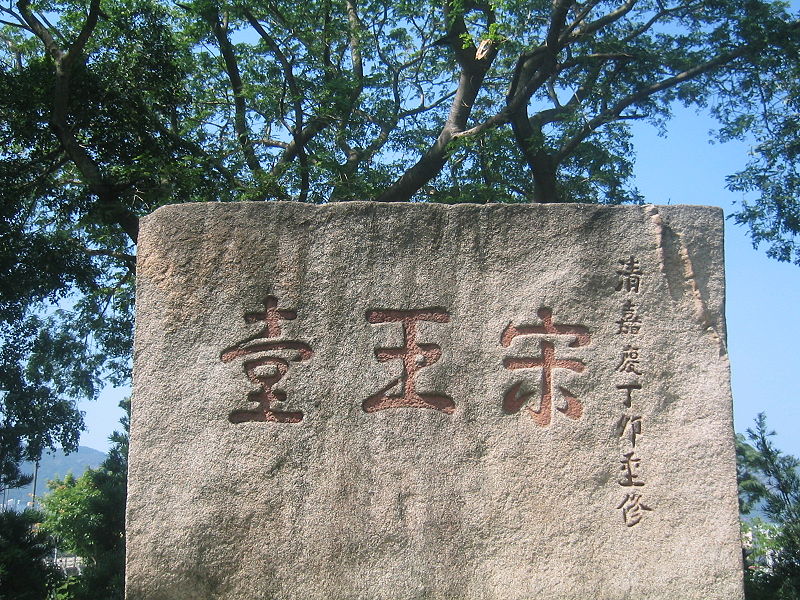
Sung Wong Toi is an important historic relic in Kowloon, Hong Kong. While its remaining portion is currently located in the Sung Wong Toi Garden in Ma Tau Wai, it was originally a 45 m tall boulder standing on the top of Sacred Hill (聖山) in Ma Tau Chung above Kowloon Bay.


The name Sung Wong Toi literally means Terrace of the Sung kings. The stone is believed to have been a memorial to the last two boy emperors of the Southern Song Dynasty, Zhao ShiZhao Bing, who temporarily lived in Hong Kong from 1277 to 1279. and

While it’s true this park is dedicated solely to a rock, there’s much more history behind it than meets the eye. The Chinese characters Sung Wong Toi were inscribed into a large boulder near Kowloon Bay in 1279 as a memorial to the last two boy emperors of the Song Dynasty. Excavation damaged the rock during the Japanese occupation, but luckily the inscription remains intact. A portion was shaped into a rectangular block and is now the park’s centrepiece.

How to get there: Take bus no. 5 or 1A from Tsim Sha Tsui Ferry Bus Terminus and get off at Prince Edward Rd East. Go back to Ma Tou Wai Rd and you will see the park after a few minutes’ walk.

Resource
http://www.timeout.com.hk/around-town/features/37271/hong-kongs-best-parks.html#panel-3
http://en.wikipedia.org/wiki/Sung_Wong_Toi

2010年10月30日 星期六

RA@ Bishop's House

The Bishop's House (會督府, 主教府) is located at 1 Lower Albert Road, Central. It is the residence and office of the Archbishop of Hong Kong.

It was originally designed as a school for Chinese students and for many years housed St Paul's College. The house's origins can be dated from 1843, when Vincent Stanton was appointed Colonial Chaplain of Hong Kong. The building was completed in 1848. When the new Diocese of Victoria was created, Stanton handed over the college property to the newly appointed bishop, George Smith.


The Bishop's House is an imposing building, both in design and proportions. The interior of the building has been completed renovated and modernized as late as 1967–1968. It has been listed as a Grade I historic building.

For Architectural style, it adopts simply and elegant design, built into a granite cornerstone. There is a bunker-style three-story octagonal tower and Western-style buildings in Hong Kong early; it’s longer than a long history of Government House.

In 2009, the Anglican Church announced that it will spend around 800 million to preserve Central buildings, here are some historic buildings will be retained and rehabilitation is following:

Bishop's House: Built in 1848, it’s a historic building now. It was built into the granite cornerstone, two-story and three-story side behind a bunker-style octagonal tower. It is The Former Bishop and St. Paul's College premises originally. It may retain for Hong Kong Sheng Kung Hui (Anglican Church) Archbishop's and will be equipped with museums, the new window-type of air-conditioners and stairs was removed in recent years and it set up facilities for the disabled person to make them conveniently.

St. Paul's Church: Built in 1911, is proposed for a historic building and adopt Gothic style. At the top of the tower has a long and pointed, as early as the Chinese Central Christian Church designed. At the upper is a chapel, lower for St. Paul's College classrooms. In World War II, churches were expropriated for the Japanese military police for training school and it’s fully opened after renovation.

Source:

2010年10月24日 星期日

RA@ Nam Koo Terrace

Have you ever heard Nam Koo Terrace (南固臺)? It is one of famous heritage in Hong Kong. As Halloween is coming soon, will you try to experience and to explore this strange and terrible place in there?Do you want to know more now?


Nam Koo Terrace (南固臺) is a Grade I Historic Building. It's located at No. 55 Ship Street, Wan Chai, Hong Kong, popularly known as "The Wan Chai Haunted House". The building is currently owned by Hopewell Holdings, a large property development company based in Hong Kong.


The two-storey red brick building was built in c.1915-1921 and owned by a wealthy Shanghai merchant family by the name of To ().

Nam Koo Terrace continued to remain under the ownership of the To family until 1988, when the property was sold to YUBA Co. Ltd.

Hopewell Holdings took over ownership of the building in 1993, which was initially acquired to be demolished in order to make way for their Mega Tower hotel project (Hopewell Centre II). However, the site has stood vacant since then; despite the fact that the company's development proposal gained Government approval in 1994. While Hopewell Holdings remains the current proprietor of Nam Koo Terrace; recent public announcements indicate that their intentions have now shifted to the preservation, rather than the demolition, of this historical site.


For architecture, it is a site of significant cultural and architectural heritage stemming from Hong Kong's Colonial Era. The building was designed as a European-style house in the 1910s when large private lots on the hillside below Kennedy Road were sold for real estate development.

Beside, it is also a two-storey mansion, incorporating strong elements of both Eastern and Western architectural styles. As one of the more prominent villas in the Wan Chai District, Nam Koo Terrace covers over two hundred square meters of land. It is also referred to as the "red house" because the majority of the building's external wall is constructed from red bricks. Today, the building exists in a ruined state due to the effects of corrosion suffered during the Japanese invasion and ineffective preservation.


As well as embracing the Colonial Eclectic style, Nam Koo Terrace also adopts Classical Revival and Italian Renaissance architectural features combined with traditional Chinese decorations and motifs. The red bricked outer wall of the building is considered to be one of the major features of its architectural construction. Besides the red brickwork; rusticated quoins, moulded cornices, and voussoired arches over the windows add to the uniqueness of the structure's architecture.


Since Nam Koo Terrace has unoccupied for a long time as there are  many haunted rumors. In 2003, there are eight peoples of youth went to abandoned ship Street South to go on an adventure, allegedly, one of the girls was running around and barking, and change the male voice with mighty, should be sent four officers to subdue her finally.

"Nam Koo Terrace" has become a famous place to shooting for horrorible film nowaday, TV series "Finale in Blood (大鬧廣昌隆)" is one of them. Are you feel interested?

Source:
http://zh.wikipedia.org/zh-hk/%E5%8D%97%E5%9B%BA%E8%87%BA
http://www.arch.cuhk.edu.hk/server2/resch/livearch/projects-wanchai_roadshow.html

2010年10月23日 星期六

KW@Hong Kong Heritage - HAW PAR虎豹別墅


Haw Par Mansion 虎豹別墅

ABOUT HAW PAR MANSION

Address:                   No.15A Tai Hang Road, Causeway Bay, Hong Kong
Site Area:                 About 2,030m²
Gross Floor Area:       About 1850m²
No. of Storeys:          4
Year of construction: 1933-1935
Land use zoning:        "Other Specified Uses" annotated "Residential Development with    
                                Historical Site Preserved In-situ" on Approved Causeway Bay 
                                Outline Zoning Plan No. S/H6/14


History

The Haw Par Mansion together with its private garden was built by Aw Boon Haw, who was known as "The King of Tiger Balm". The Mansion was the Aw's family mansion and was restricted to private use, while the Tiger Balm Garden constructed adjoining the mansion was used to be open to the public for enjoyment.

The Tiger Balm Garden has been demolished. The Mansion together with its private garden has been preserved and passed to Government since 2001.


SOURCES:http://www.hkdatabase.com/component/option,com_openwiki/Itemid,2/id,虎豹別墅/

http://www.hkdatabase.com/component/option,com_openwiki/Itemid,2/id,%E8%99%8E%E8%B1%B9%E5%88%A5%E5%A2%85/do,export_xhtml/

http://b.tvb.com/hongkongtopic/2010/10/18/%E6%B4%BB%E5%8C%96%E8%99%8E%E8%B1%B9%E5%88%A5%E5%A2%85/

2010年10月22日 星期五

C@The Hong Kong Observatory

What I want to introduce today is Hong Kong Observatory .Hong Kong Observatory known as the Royal Observatory Hong Kong  before 1997, is a department of the Hong Kong Government. The Observatory forecasts weather and issues warnings on weather-related hazards.


The Observatory was established in 1883 by the 9th Governor of Hong Kong George Bowen. Early operations included meteorological and magnetic observations.The Hong Kong Observatory was built in Tsim Sha Tsui, Kowloon Peninsula in 1883. Observatory Road in Tsim Sha Tsui is so named based on this landmark. The Observatory is now surrounded by skyscrapers as a result of rapid urbanisation. However, it remains unrelocated.

Hong Kong Observatory (134A Nathan Road, Tsim Sha Tsui) 1883 Building
This building, built in 1883, is a rectangular two-storey plastered brick structure; it is characterised by arched windows and long verandas. It now houses the office of the directorate and to serve as a centre of administration of the Observatory.

The Friends of the Observatory, an interest group set up in 1996 to help the Observatory to promote Hong Kong Observatory and its services to the public, provide science extension activities in relation to the works of the Observatory and foster communication between the Observatory and the public, now has more than 7,000 individual and family members in total.
Voluntary docents from this interest group lead a "HKO Guided Tour" to let the public who applied for visit in advance to visit the headquarter of the Observatory, and learn about the history, environment and meteorological science applied by the Observatory.


Address: 134A Nathan Road, Tsim Sha Tsui

 Source:
http://en.wikipedia.org/wiki/Hong_Kong_Observatory
www.weather.gov.hk/contente.htm
www.heritage.gov.hk/en/index.htm

2010年10月18日 星期一

HL@ Hong Kong Museum of Medical Sciences

Have you guys seen the TV programme last night?

The TV programme had introduced the 'Hong Kong Museums of Medical Sciences' (HKMMS) which was located in a renovated 3-storey Edwardian style building, at 2 Caine Lane at the Mid-levels, Hong Kong Island.


 This buidling was established in 1906 and called "Bacteriological Institute" previously. Later, it was called "Pathological Institute" after The World War II.


The Museum occupies 10,000 square feet, comprising 11 Exhibition Galleries, 1 Gallery for Tai Ping Shan View, 1 Library and 1 Lecture Room, each presents in a variety of ways to arouse interests and to help members of the community know more about health and diseases, including past conquests, current developments and future challenge of special relevance to Hong Kong. It also explores the interface between Chinese and Western medicine and encourage research in this area. It intends to serve both as an educational venue and to restore and conserve medical objects of historical value. As such, it is the first of its kind amongst medical museums in the world!

About their objectives, they want to exhibit and educate the public about Hong Kong's medical history as well as to preserve historical medical materials relating to the local development of medicine. Occasionally, special activities are held by the museum to inform the public about medical information and news. Publications and leaflets are also distributed to the public occasionally so as to help arouse the interest of the public in the medical history of Hong Kong and increase their knowledge and understanding of health and diseases. This museum is special and meaningful since it is the first of its kind among all the medical museums in the world.


This is the Herbalist Shop of HKMMS which included Chinese herbal medicines and the
traditional Chinese medical practitioner's equipment.

The design of this room is in accordance with the traditional style and concept of a Chinese herbalist shop. We can recognize many herbs from the Chinese herb shop and some them we might have actually taken before.
  

How to get there?

The museum closes on Mondays but is open to the public from 10:00a.m to 5:00p.m from Tuesday to Saturday. On Sundays and public holidays, it starts at 1:00p.m. and closes at 5:00p.m. The admission fee is HK$10.00 for adults and $5 for the disabled people, full-time students and the elderly aged 60 or above. 
  

By "Central - Mid-Levels Escalators"
Use the "Central - Mid-Levels Escalators" (after 10:30am) from Central to Caine Road, and walk westwards for around 10 minutes till you reach Ladder Street. Descend Ladder Street and turn left after the first flight of steps into Caine Lane. The Museum is down Caine Lane, on your right. [Dynamic Route (Central Market - Museum)]


The video will let you know more about Hong Kong Museums of Medical Sciences.
Check it out!

Source: 
http://www.hkmms.org.hk/
http://en.wikipedia.org/wiki/Hong_Kong_Museum_of_Medical_Sciences
http://www.discoverhongkong.com/tc/attractions/museum-medical-sciences.html