Do you know any about 'Kowloon Walled City Park'? if not, don't worry about it.
Let us introduce more about 'Kowloon Walled City Park'.
The Kowloon Walled City Park occupies one of the most historic sites in the territory.
Once strategically located at the north-eastern corner of the Kowloon peninsula and adjacent to what was to become Kowloon Bay, the site was used by imperial officials in the 15th century and was first fortified in 1668 when a signal station was established there.
The interior was dominated by the offices of the Commodore of the Dapeng Brigade, and the Kowloon Assistant Military Inspectorate, commonly known as 'Yamen'. In addition, there were more than ten numbers of military buildings including soldiers' quarters, gunpowder and ordnance magazines. Besides, some civilian houses could also be found in the City. The strength of the troops stationed there were 250 at the time of the completion of the City, which increased subsequently to more than 500 in 1898/99.
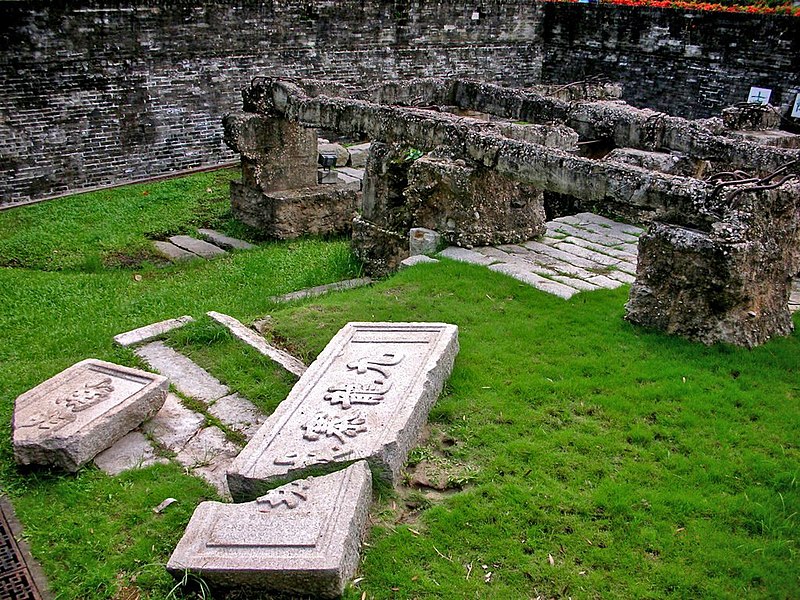
The park's design is modeled on Jiangnan gardens of the early Qing Dynasty. It is divided into eight landscape features, with the fully restored Yamen as its centerpiece. The park's paths and pavilions are named after streets and buildings in the Walled City. Artifacts from the Walled City, such as five inscribed stones and three old wells, are also on display in the park. On a green lawn surrounded by a brick wall lie broken engraved stones and stone foundations.
Remnants of the City's South Gate and its entrance plaques.
Components of the park include:
* The Eight Floral Walks, each named after a different plant or flowe
* The Chess Garden, featuring four 3 by 5 m (9.8 by 16 ft) Chinese chessboards
* The Garden of Chinese Zodiac, containing stone statues of the 12 Chinese zodiac animals
* The Garden of Four Seasons (named Guangyin Square after the small open area in the Walled City), a 300 m2 (3,200 sq ft) garden with plants that symbolize the four seasons
* The Six Arts Terrace, a 600 m2 (6,500 sq ft) wedding area containing a garden and the Bamboo Pavilion
* The Kuixing Pavilion, including a moon gate framed by two stone tablets and the towering Guibi Rock, which represents Hong Kong's return to China
* The Mountain View Pavilion, a two-story structure resembling a docked boat that provides a good view of the entire park
* The Lung Tsun, Yuk Tong, and Lung Nam Pavilions
* The Yamen and the remains of the South Gate
About the declared monuments of Kowloon Walled City Park:
The Antiquities and Monuments Office conducted archaeological examinations as the Walled City was being demolished, and several cultural remains were discovered. Among them were the Walled City's Yamen and remnants of its South Gate, which were officially designated as declared monuments of Hong Kong on 4 October 1996.
The South Gate had originally served as the Walled City's main entrance. Along with its foundations, other remains included two stone plaques inscribed with "South Gate" and "Kowloon Walled City" from the South Gate and a flagstone path that had led up to it. The foundations of the City's wall and East Gate were also discovered. The Hong Kong government preserved the South Gate remnants next to a square in front of the Yamen. The Yamen building is made up of three halls; originally the middle hall served as the Assistant Magistrate of Kowloon's administrative office, and the rear block was his residence. After the government officials left the area in 1899, it was used for several other purposes, including an old people's home, a refuge for widows and orphans, a school, and a clinic. It was restored in 1996 and is now found near the center of the park. It contains a photo gallery of the Walled City, and two cannons dating back to 1802 sit at the sides of its entrance.

Do you know who is he?
I will tell all of you in next week.
Keep checking our blog please :)
Source
http://en.wikipedia.org/wiki/Kowloon_Walled_City_Park#Kowloon_Walled_City_Park
http://www.lomographyasia.com/magazine/locations/2010/10/06/kowloon-walled-city-park
http://www.lcsd.gov.hk/parks/kwcp/b5/index.php
http://www.youtube.com/watch?v=aVlg7moyzLU&feature=related

 1883 Building